AUSTIN FERNANDEZ
Level Designer


FORT KHAROS
LEVEL BLOCKOUT
INSPIRED BY DOOM ETERNAL

WALKTHROUGH
OVERVIEW
Fort Kharos is an original level inspired by the combat philosophy and environmental design of Doom Eternal. Set within a fallen Sentinel fortress built atop a mountain peak, the project explores fast-paced combat and layered arena design while emphasizing readability and player flow.
-
Designed, blocked out, and iterated on an original Doom Eternal-inspired level.
-
Developed a custom gameplay framework including player movement, enemy AI, combat systems, and environmental mechanics to support rapid level iteration.
-
Created all environmental meshes with Unreal 5's modeling toolkit.
OBJECTIVES
-
Capture the sped and push-forward combat of Doom Eternal via high player mobility, aggressive enemy pressure and varied traversal options.
-
Design highly readable, looping arenas that reward continuous movement.
-
Convey monumental scale using simple architectural forms and layered sightlines.
-
Integrate traversal as a core component of combat and level progression.
-
Structure the level around a clear, linear progression with intuitive pathing.
SCREENSHOTS


BREAKDOWN
Approach
The approach establishes the fortress as a monumental destination while easing the player into the level's movement systems. Combat is absent, allowing the environment, sightlines, and traversal to establish anticipation before the first major encounter.
-
Introduces traversal mechanics before combat complexity.
-
Uses distant landmarks to reinforce player orientation.


Courtyard
The courtyard is the first major combat arena, and the introduction to the push-forward combat flow. Pathing wraps around a central open space, allowing players to continuously change elevation and reposition without relying on dead ends.
-
Elevations remain visually connected in a recognizable way from entering the space
-
Encourages aggressive movement over defensive positioning
Keep
The keep is a vertical combat arena, with multiple floors connected around a shared central space. Storage, the feast hall, and upper mural gallery overlook the center, encouraging players to loop between elevations while maintaining awareness of each layer.
-
Mural walkway lets player circumvent the space with longer sightlines
-
Storage area provides a break from the open space of the feast hall, and provides more ammo


Sanctum
The Sanctum concludes the level by shifting from military architecture to an ancient ritual space. Positioned on its own mountain peak, the space is build around the hell breach the player is tasked to destroy.
-
Architectural isolation reinforces narrative importance.
-
Circular layout supports continuous combat flow
-
Teleporters connect opposing sides of the arena
-
Compensates for the arena's smaller size
-
TOP DOWN MAP

BLUEPRINTS

Bar-Swing
The bar swing Blueprint can be applied on any static mesh, and uses the player's initial velocity to launch them forward and up.
Vectors are split, added to with exposed variables, and then reassembled
-
Tunable parameters per instance
-
Clamped maximum velocity
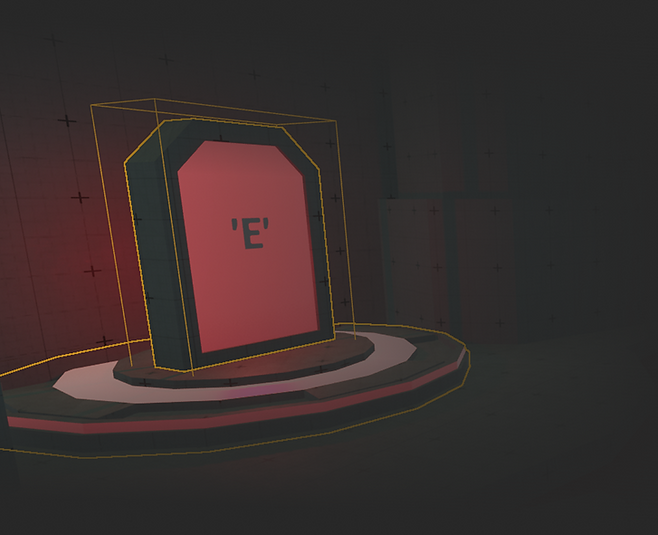
Enemy Manager
An event on the manager checks the length of an exposed array containing enemies. When the length hits zero, different things take place depending on exposed boolean variables.
If there is a valid BP_Door actor reference, the door will open. If there is a valid BP_HellGate reference, the gate will become damageable.
-
Enemies manually placed, one manager per combat encounter.
This level was built with a gameplay pack I created myself, including the player systems, weapons, and enemy AI. For a deeper dive into the gameplay systems I prototyped, see the Doom Eternal Gameplay Systems page.